Graph-theoretical approach for analysing brain activity

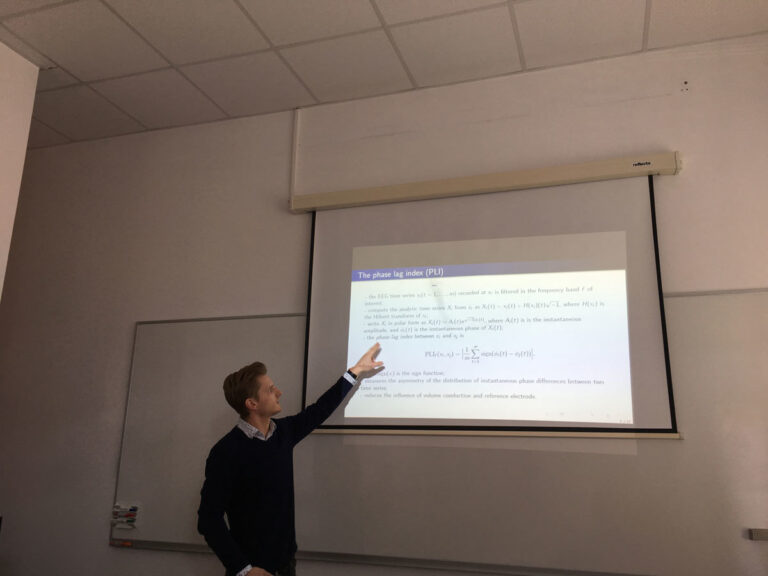
2017-11-20 10:00-11:00 FAMNIT-POŠTA Rok Požar (UP FAMNIT) Graph-theoretical approach for analysing brain activity The electrical activity generated by nerve cells of the brain can be measured through electrodes attached to various locations on the scalp.  This technique is known as…

Pentagonal Clusters in Fullerenes

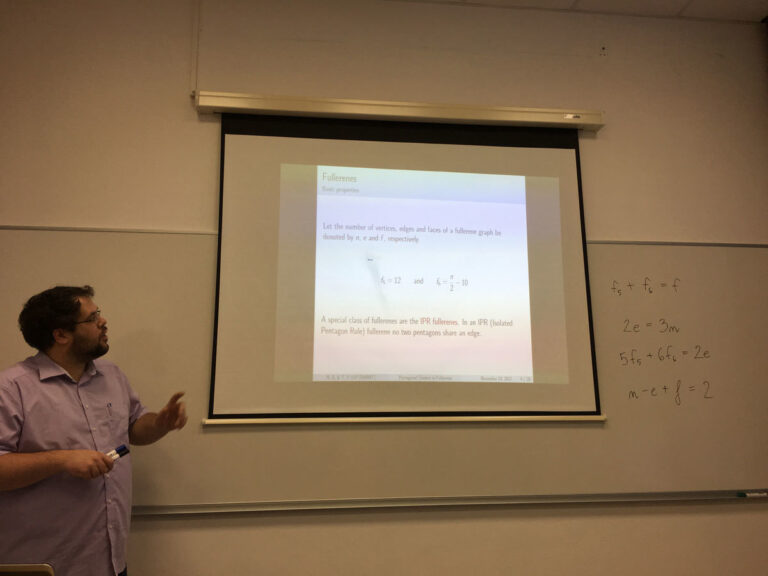
2017-11-13 10:00-11:00 FAMNIT-POŠTA Nino Bašić (UP IAM & UP FAMNIT) Pentagonal Clusters in Fullerenes Properties of fullerenes are critically dependent on the distribution of their 12 pentagonal faces. It is well known that there are infinitely many IPR-fullerenes. IPR-fullerenes can…

Highly symmetric graphs

2017-11-06 10:00-11:00 FAMNIT-POŠTA Robert Jajcay (UP FAMNIT and Comenius University (Slovakia)) Highly symmetric graphs In our talk, a highly symmetric graph will mean a vertex-transitive graph whose automorphism group is much larger than the order of the graph. We will…

Complex, symplectic and Kahler geometry

2017-11-27 10:00-11:00 FAMNIT-POŠTA Vicente Munoz Velázquez (Universidad Complutense de Madrid, Spain) Complex, symplectic and Kahler geometry Kahler manifolds appear naturally in both Algebraic and Differential Geometry: projective complex varieties from Algebraic Geometry, and smooth manifolds with riemannian metrics with holonomy…

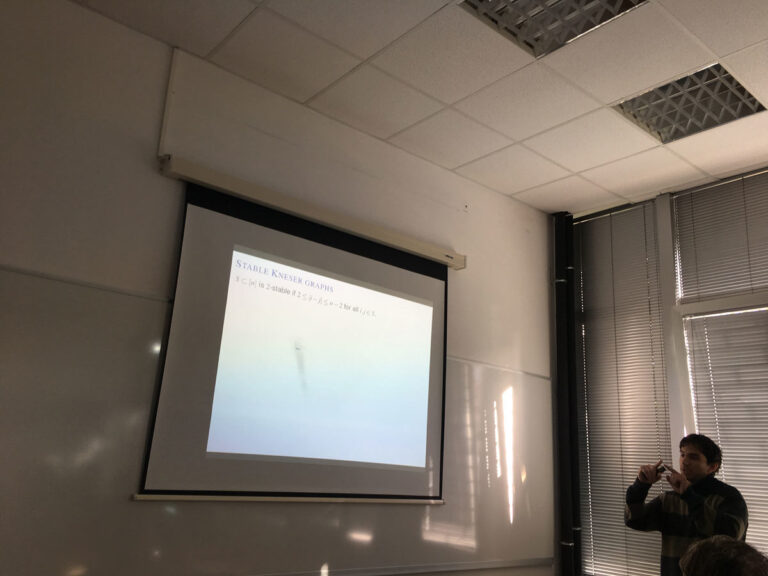
Stable Kneser graphs: problems and conjectures

2017-10-23 10:00-11:00 FAMNIT-POŠTA Pablo D. Torres (Universidad Nacional de Rosario, Argentina) Stable Kneser graphs: problems and conjectures For positive integers n \ge 2k, the Kneser graph KG(n, k) has as vertices the k-subsets of [n] = {1,…,n} and two vertices…

Accessibility Toolbar