
Univerza na Primorskem Fakulteta za matematiko, naravoslovje in informacijske tehnologije
- Študij
- Mednarodno sodelovanje
- Raziskovanje
- O fakulteti
Simon Mezgec, UP FAMNIT
 General
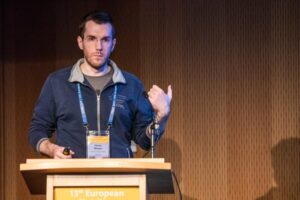
Simon Mezgec completed the undergraduate study programme in Computer Science at UP FAMNIT in 2011 and earned his master’s degree in the same field at the same faculty in 2014. He then continued his career at the Jožef Stefan Institute. Below, you can read his career story.
Could you begin by telling us a few words about yourself and your work so far?
Until 2022, I worked at the Jožef Stefan Institute as a researcher in the field of computer vision at the Department of Computer Systems, where I focused on developing deep learning solutions for food image recognition.
There, I developed an approach called NutriNet, which was the first capable of recognizing beverages as well. The work was very well received within the research community, which encouraged us to continue improving and developing similar approaches.
One of these efforts led to the development of the VID application, which uses food image recognition for automatic logging of consumed food. The application performed accurately on a limited number of food and beverage categories, but for a commercial release it needed to be expanded to a much larger variety of foods.
At that point, I decided to pursue an independent entrepreneurial path by founding the startup vysia.ai, as this gave me greater flexibility and adaptability to the market. Today, I use the knowledge gained in academia to develop a publicly available food-tracking application.
The work itself is very interesting and dynamic — since I am still at the beginning of this journey, I am responsible for everything myself. One day I might be writing applications for funding calls, the next day building contacts, then developing the application, and another day recording promotional videos.
You successfully completed both undergraduate and master’s studies at UP FAMNIT. What convinced you during your undergraduate studies to continue with a master’s programme?
The decision was actually very simple — during my undergraduate studies, I realized that choosing computer science as my field of study had been the right decision, because I still genuinely enjoy working in this field today. Because of that, it was not difficult to conclude that I wanted to continue learning more about it.
In addition, I chose computer vision as the topic of my final thesis, and I wanted to continue working on problems in this area. Most likely, none of this would have happened without the excellent professors with whom I had extremely positive experiences. Not only did they effectively transfer knowledge, but through their enthusiasm for their work they also inspired us students to continue exploring the field further.
Which knowledge and skills acquired during your studies are the most useful in your current work?
Personally, I would say that the most valuable thing I learned during my studies was how to quickly acquire new knowledge or learn a new programming language.
Computer science is a field that develops extremely rapidly, and specific knowledge and skills can quickly become outdated. However, if you understand the theory and are not afraid of learning new concepts and tools again and again, you are well prepared for any new challenge.
In my opinion, the studies offered the right balance between theory and practical projects, and I continue to make great use of those experiences in my current work. Both undergraduate and master’s studies at FAMNIT also prepared me very well for doctoral studies at the Jožef Stefan International Postgraduate School.
Could you share an interesting fact or anecdote from the development and use of your VID application for logging food and drinks through photography?
The development of the VID application is based on my work in food image recognition, which began back in 2014.
One interesting fact is that I personally also have some dietary restrictions, but these only appeared in 2015. One might expect that I started developing these kinds of solutions because of my own dietary limitations, but in reality I developed them first and only later happened to acquire dietary restrictions myself.
Regarding the application itself, it was always entertaining to encounter the names of local dishes. To this day, I still have not received a definitive answer as to what exactly “plätzli” is. I only know that it is something Swiss and somewhat similar to a steak.
Three years ago, you achieved second place at the Food Recognition Challenge, the only international competition in food image recognition, and the year before that you were among the finalists for the European DSM Bright Science Award. What are your goals for the future? Will you continue developing the application, or have you already started working on new projects?
That is correct — my current goal is to continue developing the application. The objective is for it to function across a broad range of foods and beverages from around the world and eventually become profitable.
Development is progressing encouragingly, but it is still a slow process. The experiences of successful startups also show that it can take quite a long time before end users receive a finalized version of a product.
At the same time, I am also thinking about developing a solution that would enable the collection of larger quantities of labelled data, which are crucial for training deep learning models and are currently insufficient for many different problems — food image recognition is only one example. However, this idea is still in its conceptual phase.
What would you recommend to FAMNIT computer science students on their path toward finding their first job?
I would recommend that they aim high and not settle for a job they do not enjoy. The knowledge gained at FAMNIT makes students competitive even when applying for positions at prestigious international companies.
If they have their own idea and a plan for implementing it, I encourage them not to be afraid to try to realize it — perhaps initially alongside their studies or regular work, if they are not yet fully certain about dedicating themselves entirely to that path.
What would you highlight as the biggest advantage of working in your own company?
The greatest advantage is definitely freedom — you decide the direction the company will take, its goals, schedule, and so on. Especially in the fast-moving world of computer science, this ability to adapt is a major advantage.
At the same time, however, it can also be a double-edged sword. Freedom can mean uncertainty, because you never know for certain whether you are on the right path and investing your time wisely in the right things.
Nevertheless, I personally prefer this approach because it allows for a great deal of creativity, and uncertainty itself is not such a terrible thing when we consider that we often learn the most from failures.